
Key Takeaways
- Small defects can create major risks when hoists handle heavy or awkward loads.
- Pre-use checks should include the hook, chain or wire rope, controls, brakes, limit devices, and travel path.
- Inspection intervals should reflect the equipment’s service, environment, condition, and manufacturer’s instructions.
- Accurate records help teams identify repeat defects and confirm corrective action.
- Operators should stop work when a hoist slips, drifts, makes abnormal sounds, or responds poorly.
- Maintenance, training, load planning, and defect reporting should operate as one safety system.
In Fontana, California, where warehouses, fabrication operations, distribution centers, and industrial service teams often depend on frequent material movement, hoist reliability directly affects both worker safety and daily output. Working with an Industrial Hoist Supplier Fontana CA, can help facilities select equipment and replacement components suited to their lifting demands, but safe performance still begins with disciplined inspections before every shift.
A hoist problem that appears minor at the start of the day, such as a sticky pendant button or an unusual brake sound, can become a serious interruption once a load is suspended. Consistent checks give operators a practical opportunity to find defects early, remove unsafe equipment from service, and prevent avoidable delays in busy Fontana work environments.
Why Hoist Checks Matter in Fontana Facilities?
Hoists are used to position machinery, move raw materials, load fabricated assemblies, and support maintenance work. Although a hoist is only one part of a lifting system, a defective hook, brake, chain, rope, control, or limit device can compromise the entire lift.
The basic difference between a hoist and the larger crane system supporting it is useful context when planning inspections, especially where bridge cranes travel across production areas.
Crane systems move and position loads, while the hoist provides the lifting and lowering action. For overhead and gantry cranes in general industry, OSHA classifies inspections as frequent or periodic.
Its overhead and gantry crane requirements address inspection intervals, hooks, hoist chains, wire rope, maintenance, testing, and safe load handling. A facility should also follow the manufacturer’s instructions and evaluate its own equipment configuration and job hazards.
Daily Checks Before a Lift
Operators should complete a brief visual and functional check before the first lift of the shift. The same review is appropriate after a power interruption, impact, suspected overload, extended storage, or other event that could have affected the equipment.
- Confirm the rated capacity is visible and sufficient for the intended load.
- Inspect the hook, latch, chain, or wire rope, and end connections for obvious damage.
- Check the pendant or remote controls, the emergency stop, and the normal control response.
- Test brakes and limit devices using an empty hook and a controlled procedure.
- Look for loose hardware, leaks, damaged guards, heat, vibration, or unusual noise.
- Clear people, obstructions, and unauthorized activity from the lifting area.
- Record and report defects before using the equipment.
Critical Parts to Inspect
Hooks and Latches
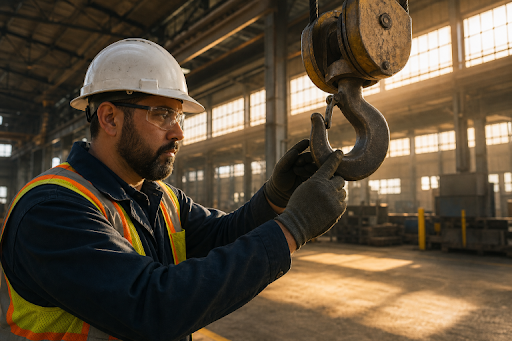
Look for cracks, bending, twisting, excessive throat opening, or a latch that does not close and function properly. Do not attempt an improvised repair through heating, grinding, or welding. The hook condition should be evaluated against the manufacturer’s criteria and applicable requirements before the hoist is returned to service.
Chains and Wire Rope
Chain inspection should consider stretch, twisted or distorted links, corrosion, cracks, wear, and end connections. For wire rope, inspect for broken wires, crushing, kinks, corrosion, heat damage, poor spooling, reduced diameter, and wear. When damage is found, document it and have an appropriate qualified person determine whether continued use is safe.
Brakes, Controls, and Limit Devices
A slipping brake can allow load drift, while delayed stopping or jerky movement may indicate a mechanical or control issue. Buttons that stick, labels that cannot be read, inconsistent speed, and intermittent response all require attention. Limit switches are protective devices and should not be used as normal stopping controls.
Building a Practical Inspection Schedule
An effective program combines routine operator checks with formal inspection, planned maintenance, and repair follow-up. The proper interval depends on service frequency, load severity, equipment age, operating environment, and manufacturer guidance.
- Before use: A visual and functional review by a trained operator.
- Frequent inspections: Reviews are scheduled from daily to monthly as appropriate for the equipment and service conditions.
- Periodic inspections: More complete examinations are scheduled according to use, exposure, and condition.
- After repair or alteration: Inspection and testing before return to service.
- After storage or extended downtime: A condition review before operation resumes.
Planning the Load and Travel Path
Safe lifting starts before an operator presses a button. Confirm the load weight, center of gravity, attachment points, rigging condition, sling angles, available headroom, and rated capacity. Plan a route that avoids employees, equipment, doorways, energized hazards, and congested staging areas.
- Identify the load and verify its weight.
- Select suitable rigging and inspect it before attachment.
- Assign an operator, signal person, or spotter when the task requires one.
- Establish an exclusion zone around the travel path.
- Perform a slow test lift to confirm balance and secure attachment.
Warning Signs That Require a Stop
Stop work when the hoist behaves differently from normal. Warning signs include brake slip, load drift, grinding or squealing sounds, jerky motion, chain jumping, uneven rope winding, hook twisting, latch failure, visible cracks, overheating, electrical arcing, or intermittent controls. When safe, lower the load, isolate and tag the equipment, notify the responsible supervisor, and arrange an inspection before further use.
Records, Training, and Team Communication
A useful inspection record identifies the equipment, date, inspector, defect, corrective action, and return-to-service approval. Digital records can make it easier to spot repeat failures, overdue reviews, and components that need closer attention.
Refresher training should cover capacity limits, controls, hand signals, rigging checks, fall zones, emergency stops, and defect reporting. Most importantly, workers should be able to pause a lift without blame when conditions appear unsafe.
Creating a Downtime Response Plan
- Clearly mark the hoist as unavailable.
- Secure the work area and protect the suspended-load zone.
- Document the symptom and the conditions when it appeared.
- Contact the assigned maintenance or inspection team.
- Use another lifting method only if it is approved and suitable for the task.
- Review repair, replacement, inspection, and testing needs before service return.
Common Questions About Hoist Safety
How Often Should an Industrial Hoist Be Inspected?
Frequency depends on the equipment, service conditions, manufacturer guidance, and applicable requirements. Daily checks are important, but they do not replace formal, frequent, or periodic inspections.
Can a Hoist Be Used if the Hook Latch Is Missing?
A missing or damaged latch should be treated as a defect. The lifting arrangement should be evaluated before use, particularly when there is a possibility that the load or rigging could become displaced.
What Should Happen After an Overload?
Remove the hoist from service until qualified personnel can assess the hook, chain, or rope, brake, controls, supporting structure, and related lifting components for damage.
Conclusion
Safe hoist operation in Fontana depends on simple habits repeated consistently every shift. Daily equipment checks, careful load planning, clear communication, reliable inspection records, trained operators, and timely repairs can help identify potential problems before they lead to injuries, equipment damage, or costly production delays.
Operators should also remain alert to changing work conditions, unusual equipment sounds, damaged components, unstable loads, or anything else that could affect a safe lift.
When something does not look, sound, or feel right, stopping the lift and addressing the concern is the right decision. A consistent safety-first approach helps create a more reliable workplace while protecting workers, equipment, and daily operations.
